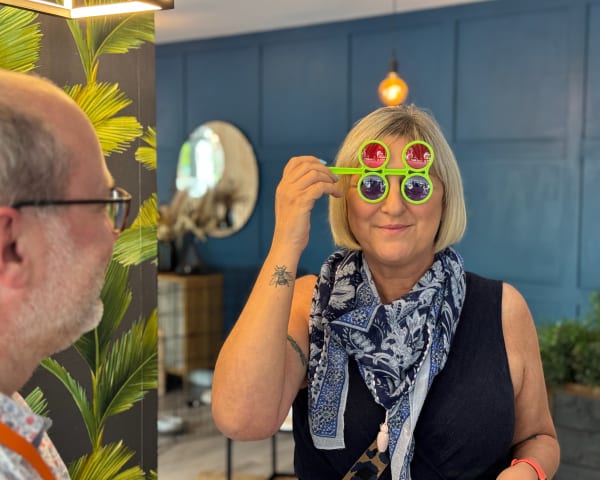
For a group of people all looking at the same scenes, living in similar environments, carrying out similar tasks, using similar devices and reading the same words in the same fonts, it is easy to assume that everyone experiences the visual world in much the same way.
In reality, while we may all look at the same things, we do not necessarily all see them in the same way. Individual visual experiences can differ enormously from person to person.
It is relatively easy to understand how someone with a cataract or a high prescription experiences the world differently from someone with good vision who doesn't need glasses. It is perhaps less obvious that, even when eyesight is otherwise good, some people find certain visual environments far more comfortable than others. Visual comfort is an individual, personal perceptual experience, making it difficult to measure objectively.
Because we all experience the world through our own eyes, it is natural to assume that what feels comfortable for us will also be comfortable for everyone else. For example, if a teacher finds a brightly lit classroom comfortable for reading, it is easy to assume the same lighting will suit every student. In reality, there are considerable individual differences in tolerance and preference for brightness, contrast, colour and repetitive patterns.
If we want individuals to achieve their best visual comfort and efficiency, it is worth considering the many factors that influence the visual environment - rather than assuming there is a single "best" arrangement of lighting, screens or reading conditions for everyone. For those who are struggling with visual discomfort it is good to consider why and to consider whether they may benefit from a change in their visual environment or a visual stress assessment.
Visual discomfort has become an increasingly important issue as modern life involves prolonged screen use, widespread adoption of energy-efficient lighting, and greater exposure to repetitive visual patterns in architecture, workplaces and digital devices.
For readers who would like to explore the science in more depth, our recent peer-reviewed review paper, A Cerebral Basis for Visual Discomfort and Visual Stress, provides an overview of the current understanding of visual discomfort and visual stress. Andrew and Katherine were co-authors of this publication, which also brings together evidence from 183 referenced studies, making it an excellent starting point for further reading.
Read the full open-access paper here.
Read the Published Abstract:
Visual discomfort or visual stress is an uncomfortable subjective experience that occurs in response to specific visual stimuli. It affects a large proportion of the population to various degrees, disproportionately impacting those with heightened sensory sensitivities, particularly neurodivergent individuals. We argue that this might stem from a mismatch between the statistical properties of visual stimuli in human-made environments and those in natural environments that the visual system can process efficiently. We discuss the inefficiency with which images with certain spatial, chromatic and temporal characteristics are processed by the visual system and propose a cerebral mechanism to account for the discomfort they induce. The mechanism offers a potential explanation for the large individual differences in susceptibility to discomfort. We highlight two avenues for intervention: (1) environmental modifications aimed at reducing the prevalence of visually stressing stimuli in urban settings, and (2) individual-level strategies, such as personalised optical treatments. Addressing these challenges requires an interdisciplinary effort bridging neuroscience, vision science, interior and urban design and typography to create visually accessible and inclusive environments.
I think this is a very unhelpful term, that can cause confusion.
Whilst some individuals may suffer from both dyslexia and visual stress, dyslexia is one condition and visual stress another.
The most recent Delphi definition of dyslexia [Carroll et al., 2025] doesn’t include visual difficulties, highlighting that although “phonological difficulties do not fully explain the variability that is observed” from individual to individual, difficulty in phonological processing is “the most commonly observed cognitive impairment”.